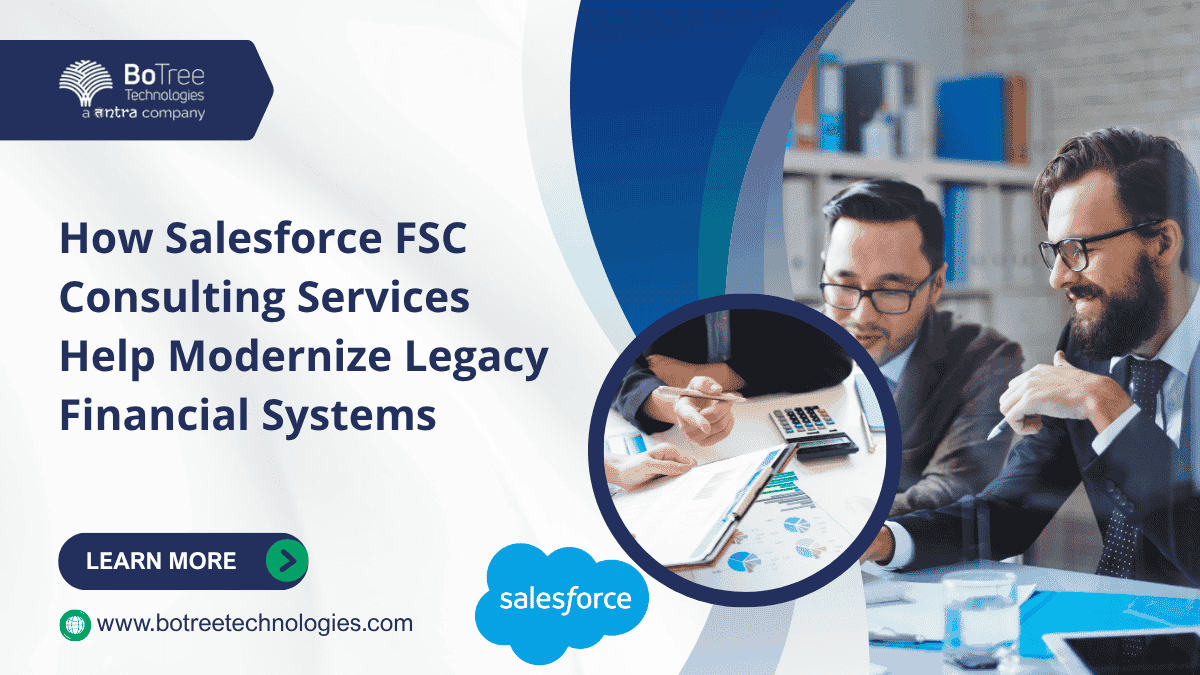
How Salesforce FSC Consulting Services Help Modernize Legacy Financial Systems
Legacy banking software drags down service, compliance, and product innovation. Our article shows how Salesforce Financial Services Cloud, customized by seasoned FSC consultants, delivers a single client view, automated workflows, and secure integrations with existing systems. A phased six‑month roadmap covers discovery, data cleanup, configuration, API connections, training, and rollout, cutting onboarding time in half and slashing IT costs. Real‑world case studies prove faster loans, richer client insights, and smoother claims. Modernization starts small, grows fast, and pays off quickly. Continue reading to learn more.
If you still move customer data from one screen to another, wrestle with nightly batch jobs, and cross your fingers during every audit, you are not alone. Many banks, insurers, and wealth managers rely on software that was built before smartphones existed. These systems slow down service, drive up costs, and frustrate both employees and clients.
Modernizing this technology debt used to feel risky and expensive. That changes with Salesforce Financial Services Cloud and skilled Salesforce FSC consulting partners. Together they give you a clear path to legacy financial systems modernization – without stopping day‑to‑day operations.
Why Legacy Systems Hold You Back
- Fragmented Data
Client details sit in one database, product information in another, and transaction records in a third. Each team builds its own work‑arounds. - Slow Product Launches
Adding a new savings plan or insurance rider often takes nine months or more because code changes ripple across multiple systems. - Rising Compliance Pressure
Regulators expect real‑time audit trails. Legacy platforms deliver reports only after manual reconciliation. - Poor Customer Experience
Clients want self‑service portals and mobile updates, but old technology cannot support them.
These pain points block growth. They also drain budgets that should fund innovation.
What Makes Salesforce for Financial Services Different
Salesforce FSC implementation brings three strengths:
- A financial services CRM designed for your industry
Household relationships, referrals, policy renewals, and KYC checks are standard features, not bolt‑ons. - Open, modern banking technology architecture
APIs connect easily with core banking, payment gateways, and analytics tools, enabling smooth Salesforce legacy system integration. - Security and scale
Data encryption, role‑based access, and continuous upgrades are baked in. You comply with global standards without heavy lifting.
With these pillars in place, financial services digital transformation becomes manageable.
The Consulting Role: Turning a Platform Into a Solution
Technology alone is not the answer. You also need a team that knows how to translate business processes into the new system. This is where Salesforce consulting services add value:
| Stage | What Consultants Do | Why It Matters |
| Discovery | Interview staff, map every data source, and document pain points. | Ensures the project solves real problems, not theoretical ones. |
| Blueprint | Design a phased roadmap for legacy system modernization. | Reduces risk by delivering quick wins first. |
| Data Strategy | Clean, de‑duplicate, and migrate records. | Bad data ruins good software; a clean start boosts trust. |
| Configuration | Build objects, flows, and dashboards with low code tools. | Aligns the platform to your exact workflows. |
| Integration | Use APIs and middleware to link core systems. | Avoids duplicate entry and maintains data integrity. |
| Testing & Training | Run user acceptance tests; create role‑based guides. | Drives user adoption and catches issues early. |
| Support | Monitor go‑live, fix errors, and plan next releases. | Keeps momentum and encourages continuous improvement. |
Good consultants speak both finance and technology. They shorten timelines and keep projects on budget.
A Practical Implementation Timeline
Below is a sample six‑month plan for financial IT modernization. Timelines vary, but the structure stays similar.
| Month | Key Activities | Expected Outcomes |
| 1 | Discovery workshops; set KPIs. | Shared vision and measurable goals. |
| 2 | Blueprint integrations and data model. | Clear scope and technical design. |
| 3 | Build core CRM objects; migrate pilot data. | Advisors access a single client view. |
| 4 | Integrate loan origination and payment APIs. | End‑to‑end process flows in test. |
| 5 | User acceptance, train champions, refine dashboards. | Staff confidence and feedback-driven tweaks. |
| 6 | Go‑live for pilot group; monitor issues; plan wider rollout. | Real users on the new system, early success metrics. |
Breaking the work into monthly milestones avoids the stress of a “big‑bang” cutover.
Real‑World Results
- Regional Bank
After moving to Salesforce FSC, loan approval time dropped from 15 days to 4. The bank now launches new products in weeks, not months. - Wealth Advisory Firm
Relationship managers saw a 20 % increase in cross‑sell revenue. A unified household view revealed opportunities hidden in separate systems. - Mid‑Size Insurer
Claims cycle time fell by 35 %. Automated alerts and document workflows replaced email chains and manual spreadsheets.
These numbers come from straightforward gains: fewer hand‑offs, automated tasks, and consistent data.
Key Benefits You Can Expect
| Benefit | Description | Typical Impact |
| Faster Service | Automated workflows replace manual steps. | Onboarding time often cut in half. |
| Better Compliance | Real‑time audit trails and field‑level security. | Fewer manual reconciliations and audit exceptions. |
| Lower Costs | Retire redundant software and hardware. | 20–30 % reduction in maintenance spend. |
| Higher Client Satisfaction | Mobile portals and proactive updates. | Improved NPS and retention. |
| Agile Product Launches | Reusable components and API integrations. | New offerings go live in months, not years. |
Because gains show up quickly, leadership support grows, fueling further financial institutions digital transformation.
Common Pitfalls and How to Avoid Them
- Scope Creep
Stick to phased goals. Each phase should have a clear business case. - Data Neglect
Do not rush migration. Poor data erodes trust and slows adoption. - Under‑training
Allocate time and budget for hands‑on sessions. A confident user base drives ROI. - Ignoring Change Management
Communicate early and often; celebrate quick wins. People, not software, decide success.
Best Practices for Sustainable Modernization
- Start Small, Think Big
Choose one high‑impact process – like client onboarding – to prove value. - Use Standard Features First
Lean on out‑of‑the‑box capabilities before custom code. Upgrades stay easier. - Automate Compliance Checks
Embed regulations into flows to avoid manual steps and late surprises. - Plan Continuous Releases
After go‑live, schedule quarterly improvements. Keep the system fresh and aligned with business goals. - Measure and Share Results
Track KPIs – cycle time, cost per transaction, revenue uplift – and report them. Transparent metrics sustain executive backing.
Conclusion
Modern clients will not wait for slow service or tolerate disjointed digital experiences. At the same time, regulators tighten requirements and new competitors emerge. Salesforce Financial Services Cloud, guided by strong Salesforce FSC consulting, gives you a practical route to leave outdated software behind and embrace efficient, compliant, and client‑friendly operations.
If managing fragmented technology keeps you from growth, it is time for a change. Map your first quick win, select a partner who knows finance, and start your journey toward a unified, modern platform. The sooner you begin, the sooner your teams and clients feel the difference.
FAQs
What is Salesforce Financial Services Cloud?
Salesforce FSC is a version of Salesforce built for banks, insurers, and wealth managers. It includes an industry‑specific data model, compliance features, and engagement tools – everything in one cloud platform.
How does Salesforce FSC help modernize legacy systems?
FSC pulls data from core banking, policy, and payment apps into a single view, automates approvals, and delivers real‑time dashboards. Manual hand‑offs disappear, errors drop, and service speeds up.
Why do banks need to modernize legacy systems?
Old platforms are costly, slow, and risky under today’s regulations. Modernizing lets banks launch products faster, meet compliance with less effort, and deliver the digital experiences customers expect.
What are the benefits of Salesforce FSC consulting services?
Consultants map your processes, clean and migrate data, build secure integrations, train users, and manage rollouts. Their expertise shortens timelines and ensures the platform fits real‑world needs.
How much does Salesforce FSC implementation cost?
Budgets vary by scope. Smaller projects start near US $100 k, while large, multi‑system rollouts can top US $1 m. A phased approach spreads investment and shows returns sooner.
How can Salesforce consultants help financial institutions?
They assess current architecture, design a modernization roadmap, configure FSC, integrate legacy systems, drive user adoption, and offer ongoing optimization – keeping the platform aligned with business goals.